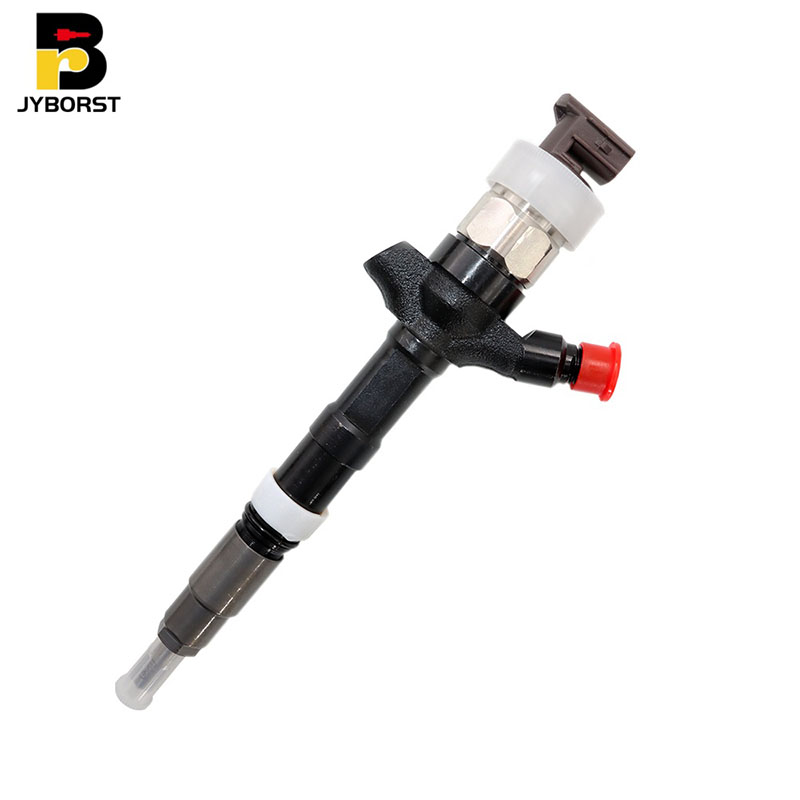
The structural composition of the fuel injector
The fuel injector is mainly composed of components such as solenoid valves, needle valves, valve bodies, spray holes, springs and armature, etc. Each component works in coordination to achieve precise fuel injection.
Solenoid valve: As the control core, it receives the electrical signal from the ECU (Electronic Control Unit). When powered on, a magnetic field is generated, attracting the armature to move. When power is cut off, the magnetic field disappears and the armature returns to its original position.
Needle valve: Linked with the armature, it controls the opening and closing of the fuel passage. When the armature moves, it drives the needle valve to lift or lower, achieving the on-off of fuel.
Valve body: It provides guidance and sealing for the needle valve, ensuring that the fuel does not leak under high pressure while forming a channel for fuel flow.
Nozzle: A key component for fuel atomization. When high-pressure fuel passes through the spray holes, it is dispersed into fine particles, forming an atomized jet and increasing the combustion area.
Spring: Provides the initial force for the needle valve to close. After the power is cut off, the spring pushes the needle valve to reset, cutting off the fuel supply.
Armature: Connects the solenoid valve and the needle valve, converting electromagnetic force into mechanical motion to drive the needle valve to open and close.
The working principle of a fuel injector
The fuel injector, through the precise control of the ECU, realizes the timed, quantified and pressurized injection of fuel. Its working process can be divided into the following steps:
ECU signal trigger: The ECU calculates the fuel injection volume based on the engine's operating conditions (such as speed, load, temperature, etc.) and sends a pulse signal to the fuel injector.
When the solenoid valve is energized: The pulse signal energized the electromagnetic coil, generating a magnetic field. The magnetic field attracts the armature, driving the needle valve to overcome the spring force and lift.
Fuel injection: After the needle valve is lifted, the fuel passage opens, and high-pressure fuel is atomized and sprayed out from the injection hole. The atomized fuel is thoroughly mixed with air to prepare for combustion.
Signal interruption: The ECU stops sending pulse signals, the electromagnetic coil is de-energized, and the magnetic field disappears.
Needle valve reset: The spring force pushes the needle valve to reset, cutting off the fuel supply and stopping the injection.
The influence of fuel injectors on engine performance
Atomization quality: The shape and size of the spray holes directly affect the atomization effect of the fuel. Fuel with fine atomized particle size and uniform distribution can mix with air more quickly, improve combustion efficiency and reduce emissions.
Fuel injection volume control: The ECU controls the fuel injection volume by adjusting the width of the pulse signal (power-on time). The fuel injector needs to respond quickly to the ECU instructions to ensure accurate fuel injection volume and avoid insufficient engine power or excessive fuel consumption.
Fuel injection timing: The fuel injector needs to spray fuel at the optimal time to ensure that the fuel mixes with the high-temperature and high-pressure air at the end of the compression stroke, achieving efficient combustion. Timing deviation can lead to engine knocking or incomplete combustion.
Durability: The fuel injector needs to withstand high-temperature and high-pressure environments and open and close frequently. Its sealing performance, wear resistance and corrosion resistance directly affect the service life and engine reliability.

 Products
 CH
CH
 Tel:+86 15993101313
  Contact:Mr. Hu
 E-mail:gyboersite@163.com
 Alibaba:
 Wechat consultation
 tiktok
 +86 159 9310 1313